If you own or manage a commercial, industrial or multi-residential property in Ontario, keeping portable fire extinguishers inspected and maintained isn’t a best practice — it’s a legal obligation under the Ontario Fire Code. Here’s what the law actually requires, who can do the work, and how to keep records that will stand up to a fire inspector.
What Ontario law requires
Fire safety in Ontario is governed by the Fire Protection and Prevention Act, 1997 and its regulation, the Ontario Fire Code (O. Reg. 213/07). Portable extinguishers are dealt with in Section 6.2 of Division B, which adopts NFPA 10, “Standard for Portable Fire Extinguishers,” by reference. In practice that means the maintenance schedule every Ontario building must follow is the NFPA 10 schedule.
Enforcement is carried out by your local municipal fire department, with the Office of the Fire Marshal (OFM) providing provincial oversight. A fire inspector can enter and inspect your premises, and can issue orders to correct deficiencies.
The inspection and maintenance schedule
Under NFPA 10, every portable extinguisher follows four intervals:
- Monthly inspection — a quick visual check that the extinguisher is in its place, unobstructed, fully charged and undamaged. This can be done by the owner or a designated employee.
- Annual maintenance — a thorough examination by a qualified technician.
- 6-year internal examination — for most stored-pressure extinguishers.
- 12-year hydrostatic test — pressure-vessel testing, or sooner if damage or corrosion is found.
For the full step-by-step list of what each inspection covers, see our complete fire extinguisher inspection checklist.
Who can perform the work
The monthly inspection can be performed in-house by the building owner or a designated employee — no certification required. The annual maintenance, internal examination and hydrostatic testing must be carried out by a qualified person, typically a technician working for a fire protection service company. This is where most Ontario businesses rely on a fire protection contractor to stay compliant.
Record-keeping: proving compliance
An inspection you can’t prove is, to a fire inspector, an inspection that didn’t happen. Each extinguisher must carry a tag showing its service history, and you should keep records of monthly and annual inspections available on site. Paper tags fade, get lost or go unchecked — which is exactly where failed inspections come from.
What happens if you don’t comply
Non-compliance with the Ontario Fire Code can lead to inspection orders, fines and — in the event of a fire — serious insurance and liability consequences. Beyond the legal risk, an extinguisher that hasn’t been maintained may simply fail when someone needs it. Confirm the specific requirements for your building with your local fire department, as municipal interpretation and additional requirements can vary.
How FireTag keeps Ontario businesses compliant
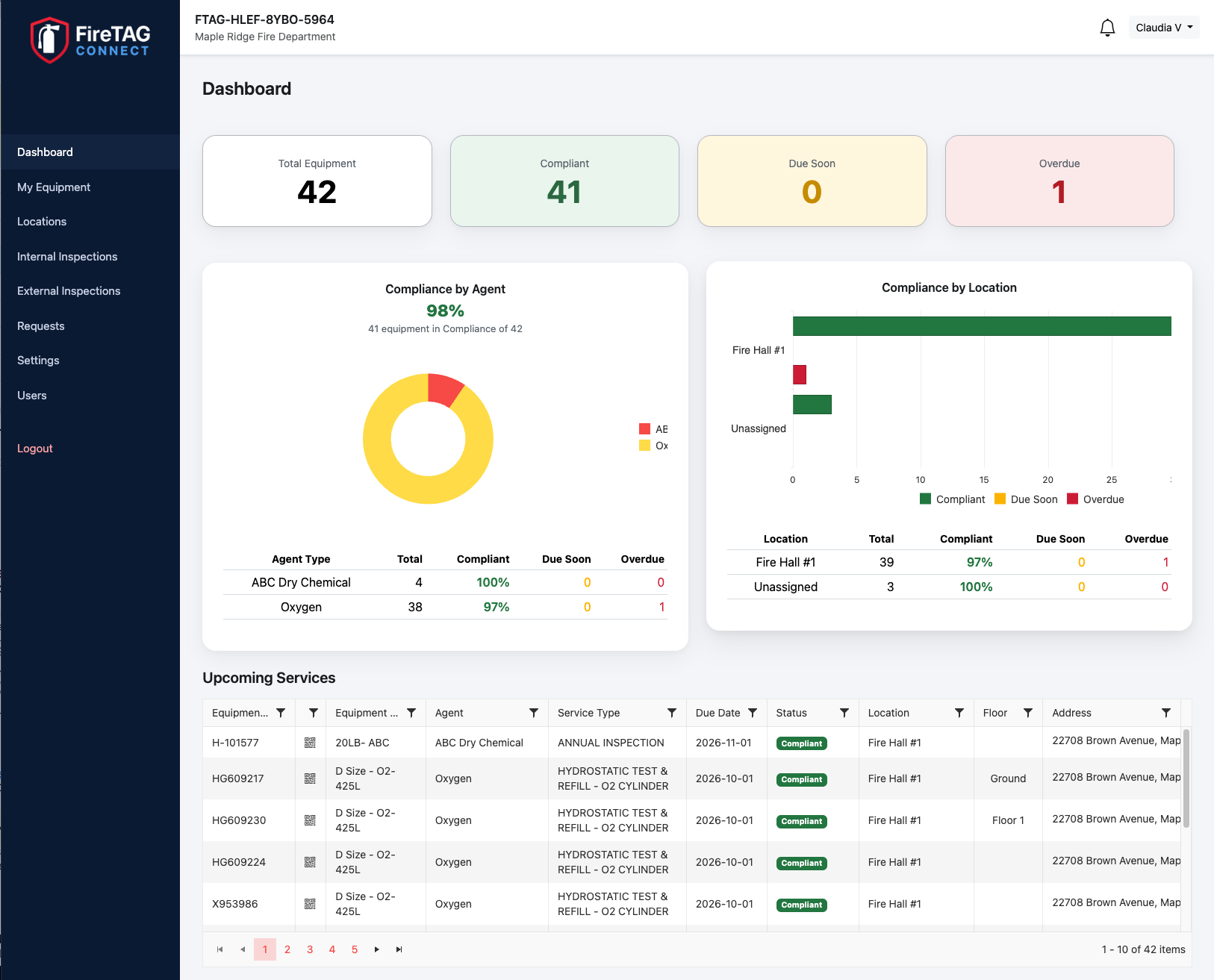
FireTag puts a QR tag on every extinguisher. One scan shows its full history, the next due date and its current compliance status — and FireTag reminds you before any inspection lapses. For fire protection companies, that means never missing an annual service; for building owners, it means a clean, defensible record for every fire inspection.
Book a free demo and see how FireTag keeps your Ontario fire equipment on schedule.
Across Canada: see how the rules compare in our province-by-province guide to fire extinguisher inspection requirements.
about
FireTag
FireTag is QR-based fire equipment tracking software for fire protection companies. One scan shows full equipment history, compliance status and automated inspection reminders.