There is no single “Canadian” fire extinguisher law. Fire safety in Canada is set province by province, so the code you answer to, who enforces it and who is allowed to service your equipment all depend on where your building is. The good news: the actual inspection schedule is remarkably consistent, because provincial fire codes adopt the same underlying standard. This guide explains the framework and links to the detailed rules for each province.
The one thing that’s the same everywhere: NFPA 10
Whatever province you’re in, the portable-extinguisher provisions of the fire code adopt NFPA 10, “Standard for Portable Fire Extinguishers,” by reference. That’s why the schedule — monthly inspection, annual maintenance, a 6-year internal examination and a 12-year hydrostatic test — is the same from British Columbia to Ontario. For the step-by-step detail of each interval, see our complete inspection checklist.
What changes by province
What differs is the governing code and edition, who enforces it, and sometimes who is allowed to perform the annual service. Here’s how the three largest provinces compare.
| Province | Governing fire code | Enforced by | Detailed guide |
|---|---|---|---|
| Ontario | Ontario Fire Code (O. Reg. 213/07), under the Fire Protection and Prevention Act, 1997 | Municipal fire departments; Office of the Fire Marshal (OFM) | Ontario requirements |
| British Columbia | BC Fire Code, under the Fire Safety Act | Local fire departments; Office of the Fire Commissioner | BC requirements |
| Alberta | National Fire Code – 2023 Alberta Edition, under the Safety Codes Act | Safety codes officers; municipal fire authorities | Alberta requirements |
Who can perform inspections
In Ontario, BC and Alberta, the monthly inspection can typically be done in-house by the owner or a designated employee — no certification needed. The annual maintenance, internal examination and hydrostatic testing must be done by a qualified technician, usually working for a fire protection service company. Some provinces, such as Alberta, are explicit that this must be a certified fire extinguisher shop — check your provincial guide above.
Record-keeping: the requirement everyone underestimates
In each of these provinces, each extinguisher must carry a service tag, and you must be able to produce inspection records on request. To a fire inspector, work you can’t document is work that didn’t happen — which is how businesses with properly serviced equipment still fail inspections. This is the single biggest weakness of paper-based tracking.
How FireTag keeps you compliant in any province
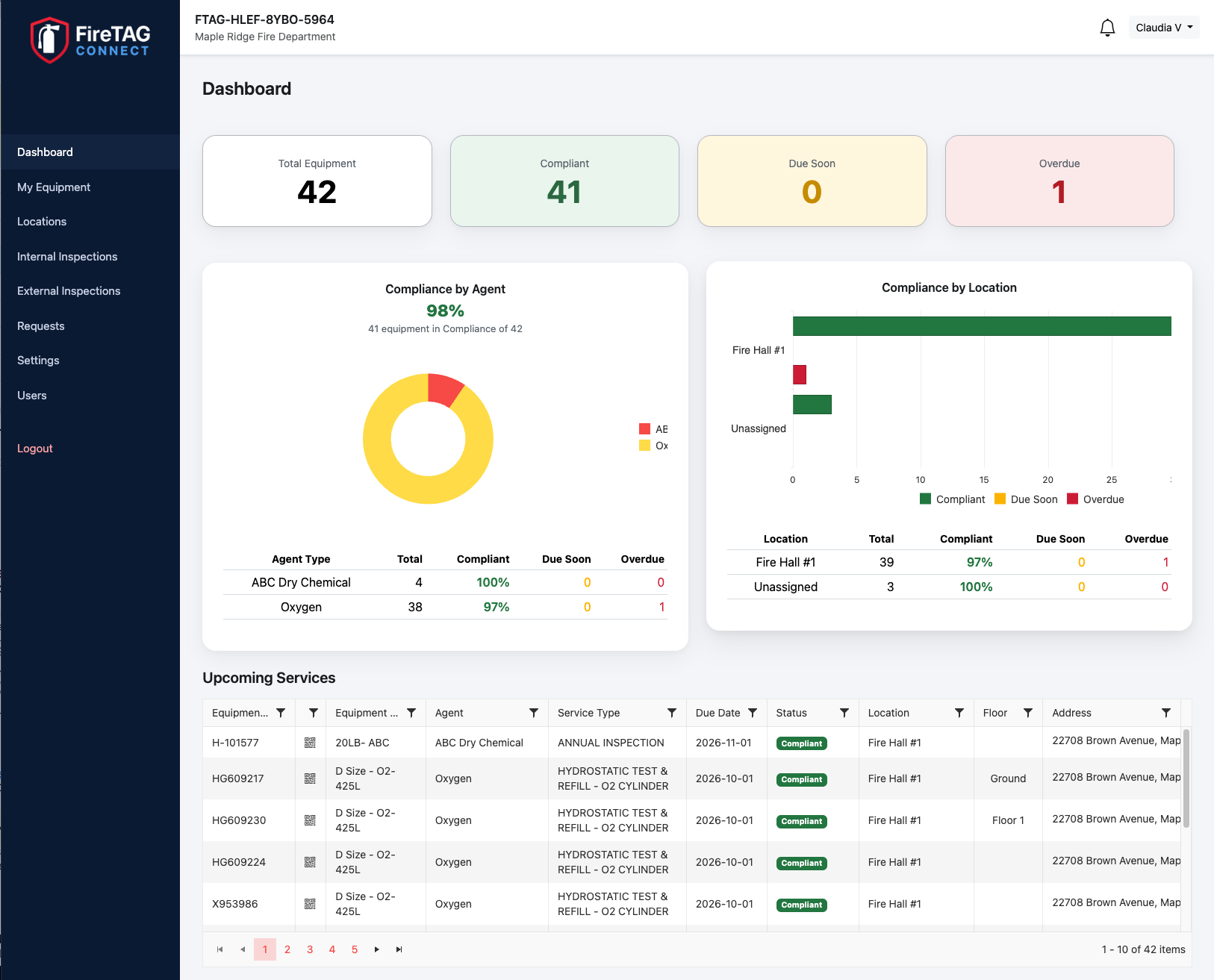
FireTag puts a QR tag on every piece of equipment and keeps its full inspection history, next due date and compliance status one scan away. It reminds you before any monthly or annual service lapses, and gives you a clean, defensible record for whichever authority has jurisdiction over your building — in Ontario, BC, Alberta or anywhere in North America.
Book a free demo to see how FireTag keeps fire equipment compliant across every site you service.
about
FireTag
FireTag is QR-based fire equipment tracking software for fire protection companies. One scan shows full equipment history, compliance status and automated inspection reminders.